Motion sensor night lights have quietly become a home staple, and for good reason. Whether you’re navigating a dark hallway at 2 a.m., keeping tabs on a teenager’s late-night bathroom trips, or simply wanting hands-free convenience, a motion sensor night light with automatic activation beats fumbling for a wall switch. These compact, battery-powered devices, from basic LED night light models to advanced smart versions, offer security, energy savings, and practical illumination without the hassle. In 2026, the technology is affordable, reliable, and far more versatile than it was even five years ago. This guide covers everything you need to know about selecting, installing, and maintaining the right motion sensor night light for your home.
Table of Contents
ToggleKey Takeaways
- Motion sensor night lights enhance home safety by reducing tripping hazards in hallways, staircases, and bathrooms while using less than 1 watt of power per activation.
- A quality motion sensor night light with PIR sensor technology detects body heat and movement, automatically illuminating for 15 seconds to 5 minutes depending on your timer settings.
- Optimal placement for motion-activated night lights includes hallways, bathrooms, stairways (top and bottom), and kitchens—mounted 18–24 inches up walls to catch body-height movement.
- Battery-powered motion sensor night light models ($15–30) offer DIY-friendly installation with peel-and-stick adhesive, making them ideal for renters and quick setup without wall damage.
- Adjustable sensitivity settings, warm white color temperature (2700K–3000K), and 20–50 lumens brightness are essential features to prioritize when choosing a motion sensor night light for your home.
Why Motion Sensor Night Lights Are Worth Adding to Your Home
A motion sensor night light solves a handful of real problems without adding clutter or complexity. First, there’s safety: tripping hazards in hallways, staircases, and bathrooms send thousands of people to the emergency room each year. Soft, automatic lighting cuts that risk significantly. Second, they’re energy-efficient, motion-activated units only run when needed, unlike permanently lit fixtures. An LED night light with motion sensor typically uses less than 1 watt when active, making them negligible on your power bill.
There’s also the sleep factor. Unlike wall switches or overhead lights that jolt you awake, a motion-activated night light provides gentle, directional illumination. Parents use them in nurseries and hallways: elderly homeowners use them to navigate safely at night: and renters love them because installation takes two minutes and leaves no holes.
Beyond convenience, motion sensor night lights are genuinely affordable. Basic models run $15–30: mid-range LED options with USB charging cost $25–50: smart-home integrated versions might reach $60–80. For the safety and peace of mind they deliver, that’s a solid return.
How Motion Sensor Night Lights Work
Most motion sensor night lights use one of two sensor types: passive infrared (PIR) or microwave-based motion detection. PIR sensors detect body heat and movement, they’re the standard because they’re reliable, affordable, and don’t require constant power to scan. When motion is detected, a circuit closes, the LED illuminates, and a built-in timer keeps the light on for a preset duration (usually 15 seconds to 5 minutes). Once movement stops, the light fades or cuts off.
Microwave sensors, by contrast, emit a low-frequency signal and detect reflections from moving objects. They work through light walls and obstacles better than PIR, but cost more and consume slightly more power. For home use, PIR is the standard choice.
Power sources vary. Battery-operated models (AA, AAA, or rechargeable lithium cells) are most popular for renters and quick installations. Plug-in versions offer unlimited runtime but require an outlet nearby. Some premium LED night light with motion sensor models include USB charging ports, making them flexible for different rooms. Brightness typically ranges from 10 to 100 lumens, enough to navigate safely without waking a sleeping partner.
Key Features to Look for When Choosing a Motion Sensor Night Light
When shopping for a motion sensor night light, prioritize these features:
Sensor sensitivity and range. Look for adjustable settings. A light that triggers every time the furnace kicks on is useless: conversely, one that misses gentle motion is equally frustrating. Most quality units let you dial sensitivity up or down. Effective range indoors is typically 6–15 feet, depending on the model.
Color temperature. Motion sensor night lights come in warm white (2700K–3000K, softer on the eyes), cool white (4000K–5000K, more clinical), or color-changing (dimmable or RGB). Warm white is best for bedrooms and hallways: cool white works in garages or basements. Test the color in your space if possible, what looks good on a shelf doesn’t always work in your hallway.
Brightness (lumens). A night light doesn’t need to be bright, but it needs to be functional. 20–30 lumens is adequate for hallway navigation: 50+ lumens works for staircases. Avoid overly bright models unless you’re lighting a basement workshop.
Timer and on/off modes. Automatic mode (motion-triggered) is standard, but manual on/off options are handy. Some models offer always-on settings for when you want continuous light. Adjustable timers are valuable, 30 seconds might work for a hallway, but 2–3 minutes suits a bathroom better.
Power source. Recent reviews of top night light options highlight battery life, USB charging, and plug-in convenience as key decision factors. If your chosen location lacks outlets, battery power is essential. Rechargeable lithium units last longer than disposable batteries and reduce waste.
Mounting and size. Compact units fit outlet covers or sit on shelves: larger models mount on walls. Consider your space, corner mounting often works best to avoid shadows and maximize sensor coverage.
Best Locations to Install Motion Sensor Night Lights
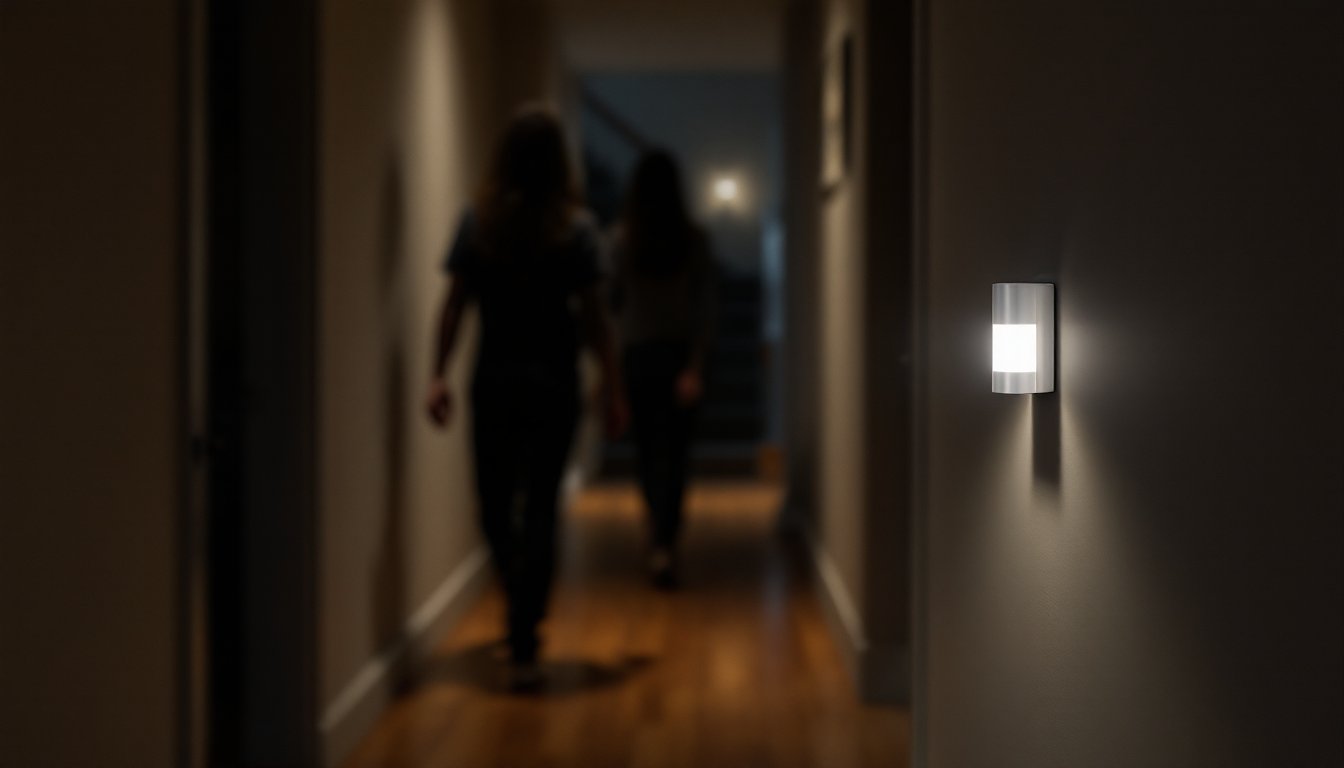
Strategic placement makes all the difference. Hallways are the most obvious choice, a motion-activated light at the end of a dark corridor guides traffic safely without flipping switches. Install one 3–4 feet from the floor so the sensor catches body-height movement.
Bathrooms benefit enormously. A night light with motion sensor placed near the toilet or sink provides lighting for nighttime visits without full ceiling fixture brightness. Keep it low enough that it doesn’t shine directly into eyes.
Stairways need careful placement. Install a motion sensor night light at the top and bottom of stairs, roughly 18–24 inches up the wall. This ensures the sensor triggers when someone approaches, and the light illuminates the treads.
Kitchens work well, too. A motion-activated LED night light near the refrigerator or on a counter provides safe navigation for midnight snacks. Basements, garage entry points, and laundry rooms are other practical locations, anywhere dark passages or steps create tripping hazards.
Bedrooms can be tricky. Parents often install motion-activated lights in nurseries or kids’ rooms to check on children without turning on bright overhead lights. Place the light where it illuminates the room without shining directly on sleeping faces. Dimmer models (20–30 lumens) work best here.
Considerations like the night light motion sensor sensitivity to pets or HVAC vents matter, too. If your cat triggers false activations, adjust the sensitivity or choose a model with pet-immunity settings.
Installation and Setup Tips for DIY Enthusiasts
The beauty of a motion sensor night light is that installation is genuinely DIY-friendly. For battery-powered models, there’s almost nothing to do: insert batteries (AAA, AA, or recharge if applicable), peel off the adhesive backing, and stick it to a clean, dry surface. Clean the wall or outlet area with a dry cloth first, dust and residue prevent adhesive from bonding properly.
For plug-in models, choose an outlet close to your target location. Position the light so the sensor has a clear field of view (not blocked by furniture or curtains). Most plug-in units can be oriented vertically or at angles: experiment to find the best angle for your layout.
Mounting on walls requires minimal hardware. If your motion-activated night light includes a wall bracket, mark the screw holes with a pencil, drill pilot holes (use a 1/16-inch bit), and install the included screws. For drywall, use the anchors provided if the light is heavier than a few ounces. Avoid mounting directly into studs unless your light’s weight and the manufacturer’s instructions specifically allow it, most night lights are too light to need that.
Once installed, test the motion detection. Walk past it at various distances and speeds. If it doesn’t trigger, adjust sensitivity (usually a small dial or potentiometer inside the battery cover). If it triggers constantly, lower sensitivity or relocate it away from air vents and heat sources. Adjustment may take a few days of use to dial in perfectly.
For renters, peel-and-stick models are ideal because they leave no holes. If you move, they peel off cleanly and reapply elsewhere. Just make sure your lease permits them, most landlords don’t object to motion sensor night lights.
Maintenance and Troubleshooting Your Motion Sensor Night Light
Motion sensor night lights are low-maintenance, but a few issues crop up occasionally. Battery-powered units should have their batteries replaced every 6–12 months (or more frequently if they’re used heavily). Keep a battery type handy, note whether your light uses AAA, AA, or 9V batteries. Rechargeable units should be topped off monthly if not in heavy use.
Dust and dirt accumulate on sensor lenses over time, reducing sensitivity. Wipe the lens with a soft, dry cloth monthly. Don’t use water or solvents, these damage the internal circuitry. If a light stops responding, a dusty sensor is often the culprit.
False triggers are common in basements and garages. Furnaces, space heaters, and fan vents emit infrared, which PIR sensors can mistake for motion. Lower the sensitivity setting or relocate the light away from heat sources. Pet-immune motion sensor night lights use dual-sensor technology to ignore animals under 50 pounds, reducing false activations.
Dimming or weak light suggests dying batteries or a failing LED. For battery units, swap in fresh batteries first. If the light still dims, the LED or circuit is failing, and replacement is cheaper than repair.
Range issues often stem from incorrect angle or obstruction. Most motion sensor night lights work best when pointed at waist-to-chest height and angled toward expected foot traffic. Reposition the unit if coverage seems patchy.
When researching replacements or upgrades, comprehensive reviews of motion-activated options and tested night light selections offer detailed comparisons across brands, power sources, and features. These resources help narrow choices if you’re upgrading from a basic model.
Conclusion
A motion sensor night light is one of those small upgrades that delivers genuine, everyday value. Whether you’re installing a single LED night light with motion sensor in a hallway or outfitting multiple rooms, the combination of safety, energy efficiency, and convenience is hard to beat. Start with high-traffic areas like staircases and hallways, test the placement and sensitivity, and expand from there. With proper placement, a modest investment in a quality motion-activated unit will pay dividends in safety and peace of mind for years.