Hard water isn’t just a nuisance, it’s a budget killer. Mineral deposits in your pipes, reduced soap efficiency, and grimy buildup on fixtures add up fast. If your dishes spot after washing or your water feels slippery, you’ve got a water hardness problem. The good news? You don’t need to call a plumber or install a complicated system overnight. Water softeners come in several flavors, each with different trade-offs in cost, maintenance, and effectiveness. Understanding your options helps you pick the right one for your home without overpaying or ending up with something that doesn’t fit your needs.
Table of Contents
ToggleKey Takeaways
- Hard water causes mineral scaling that reduces appliance lifespan by 3–5 years, making water softener options essential for protecting your home’s plumbing and budget.
- Ion exchange water softeners are the most proven technology, costing $500–$2,500 installed, but require regular salt purchases and ongoing maintenance like checking salt levels monthly.
- Salt-free water softening systems offer a low-maintenance, environmentally friendly alternative at similar price points, though they don’t eliminate hardness as effectively as ion exchange systems.
- Before choosing a water softener, test your water hardness through a free utility report or $25–50 lab test, then use the sizing formula (hardness PPM × daily household gallons used) to match the right system to your home.
- Magnetic and electronic softeners are inexpensive but lack strong scientific evidence for effectiveness—they’re worth trying only if you have mild hardness under 120 PPM and can track results over three months.
- Professional installation costs $500–$1,500 additional and is recommended to avoid leaks, plus verify local permits and regulations before purchasing any water softener system.
Understanding Water Hardness and Why It Matters
Water hardness measures the concentration of dissolved minerals, primarily calcium and magnesium, in your supply. These minerals aren’t harmful to drink, but they wreak havoc on appliances, plumbing, and your wallet.
Hardness is measured in parts per million (PPM) or milligrams per liter (mg/L). The USDA categorizes water as follows: 0–60 PPM is soft, 61–120 PPM is moderately hard, 121–180 PPM is hard, and above 180 PPM is very hard. Most homeowners start noticing problems around 120 PPM. Hard water reduces detergent effectiveness, causes mineral scaling inside water heaters (which tanks 3–5 years off their lifespan), and leaves white crusty deposits on showerheads and faucets.
Your water supplier usually provides a hardness report, or you can buy a simple test strip from any hardware store. If you’re serious about sizing a softener, get a lab test, it’s more accurate than a strip and costs around $25–50.
Ion Exchange Water Softeners: The Most Popular Choice
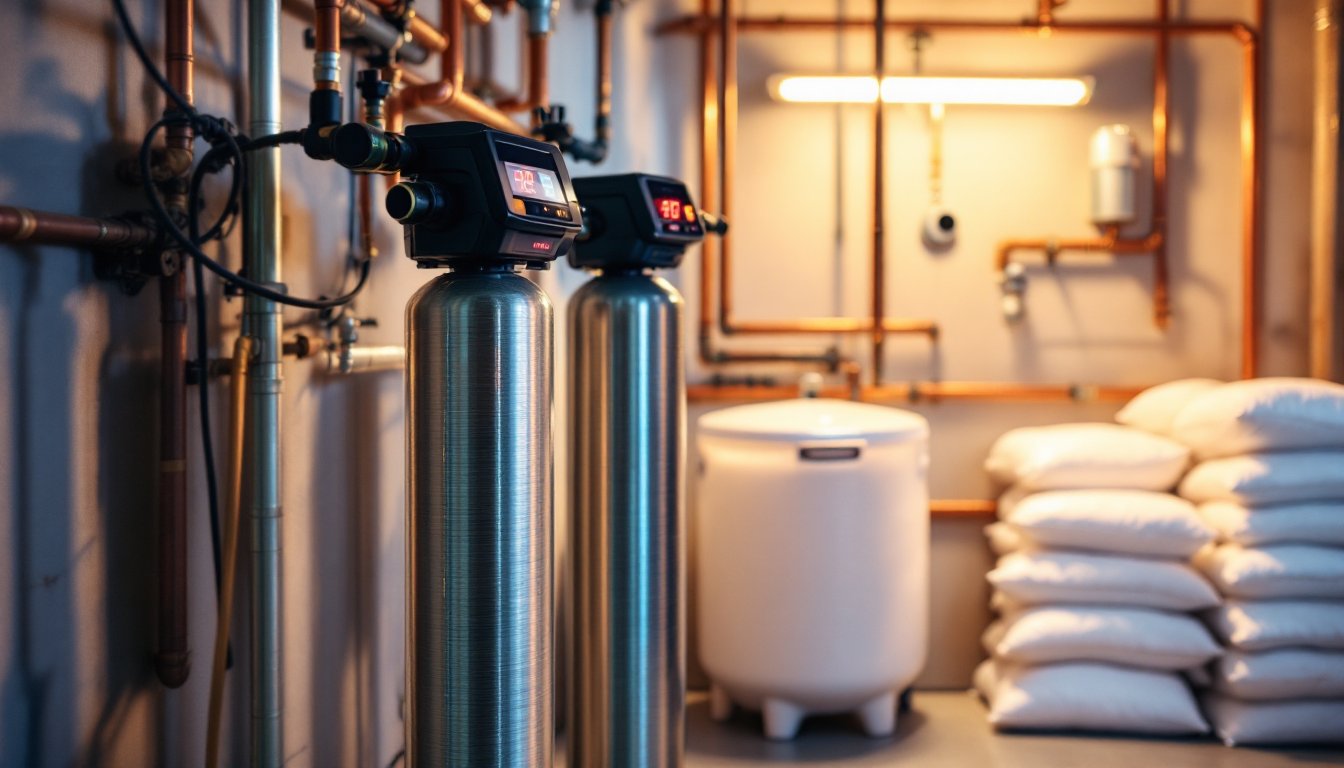
Ion exchange softeners are the workhorse of home water treatment. They swap calcium and magnesium ions for sodium (or potassium) ions through a resin bed. When the resin gets saturated, the system “regenerates” by flushing salt brine through it, rinsing away hardness minerals and recharging the resin.
What you’re getting: Proven, reliable technology that actually softens water. A typical system handles households up to about 4 people and costs $500–$2,500 installed (or $800–$2,000 for DIY installation if you’re comfortable with basic plumbing). They’re rated by “grains per gallon” (GPG), your water hardness multiplied by daily household water use determines the size you need. A family of four in a 120 PPM area might need a 32,000-grain unit.
The catch: Salt regeneration means you’re buying bags of salt every 6–8 weeks (budget $5–15 per bag), and the system requires a drain line. Some municipalities restrict sodium discharge, and the resulting slightly salty water isn’t ideal for dialysis patients or those on low-sodium diets. Maintenance is straightforward: check salt levels monthly and clean the brine tank annually.
Top units from manufacturers like Culligan or Water Softeners Inc. offer digital controls and efficiency ratings. Read full-length product reviews to compare specific models in your budget range.
Salt-Free Water Softening Systems: An Alternative Approach
Salt-free systems don’t soften water in the traditional sense, they condition it by preventing mineral buildup using template-assisted crystallization (TAC) or other media-based methods. Minerals stay dissolved but don’t scale pipes or fixtures.
The appeal: No salt to buy, no brine discharge, and lower environmental impact. They’re smaller, cost $600–$2,500 installed, and need little maintenance beyond occasional media replacement (every 3–5 years). If sodium restrictions concern you or you want a green option, this is worth considering.
The reality check: They don’t eliminate hardness, soap still won’t lather as well as with true softening, and mineral-dependent appliances don’t get the same protection. They work best on water below 200 PPM and in homes with moderate use. High-flow households (lots of showers, laundry) may see reduced effectiveness. Reviews vary widely because performance depends heavily on incoming water chemistry and exact usage patterns.
Magnetic and Electronic Water Softeners: What You Need to Know
Magnetic and electronic systems claim to alter water structure using magnets or electrical pulses to prevent scaling. They’re cheap ($200–$800), require zero maintenance, and don’t add salt or waste water, sounds perfect, right?
Here’s the problem: Scientific evidence for their effectiveness is weak. Most studies funded by manufacturers show results, but peer-reviewed, independent research doesn’t consistently support the claims. Water hardness minerals still remain in the water: the idea is that they won’t stick to pipes. Real-world reports from homeowners are mixed, some swear by them, others see no difference.
They might be worth trying if you have mild hardness (under 120 PPM) and want to avoid salt, but don’t expect the same results as an ion exchange softener. If you’re skeptical but curious, keep receipts and track your water consumption and fixture scaling over three months. You’ll know quickly whether it’s working for your home.
How to Choose the Right Water Softener for Your Home
Testing Your Water Hardness Level
Before shopping, know your enemy. Hardness varies by region and even neighborhood. Call your local water utility and request a water quality report, they’re required to test regularly and provide results free. If you’re on a well or want a more complete picture, buy a lab test through the EPA-approved route (about $25–50) or use a basic test strip ($5–10) as a starting point.
Note the hardness in PPM, iron content, pH, and any other contaminants (some softeners handle more than just hardness). This data is essential for sizing and choosing between technologies.
Sizing and Installation Considerations
Size matters. An undersized softener regenerates constantly and wastes water and salt: an oversized one is overkill and costs more upfront. Most manufacturers provide sizing calculators. Here’s the basic formula: Hardness (PPM) × Daily household water use (typically 100–150 gallons per person per day) = GPG demand.
A family of four in a 150 PPM area uses roughly 150 × 600 gallons = 90,000 GPG per day. You’d want a unit that can regenerate daily without running out, so a 40,000–50,000 grain softener would work (regenerating every 1–2 days).
Installation reality: Ion exchange systems need a drain line, access to cold water input, a 120V outlet (for digital controls), and clearance for salt bags. Salt-free systems are smaller but still need bypass valves. Magnetic units clip on and require no plumbing, but again, the science is iffy. If plumbing intimidates you, hire a pro, a bad install means leaks and wasted money. Budget $500–$1,500 for professional installation on top of the softener cost.
Permits: Check local code. Some jurisdictions require permits for water treatment systems: others don’t. Call your building department first. Softener discharge into septic systems requires careful consideration, consult your septic installer or pump service before committing.