Flat roofs are practical, space-efficient, and increasingly common on modern homes and additions. But when leaks, cracks, or blisters appear, they demand quick attention, water damage compounds fast, and ignoring a small problem can turn into a five-figure nightmare. The good news: flat roof repair options range from quick sealant patches you can handle yourself to professional membrane replacements that restore your roof for decades. Understanding what’s wrong, what you can safely fix, and when to call a licensed roofer is the first step to protecting your investment and keeping your home dry.
Table of Contents
ToggleKey Takeaways
- Flat roof repair options range from affordable DIY patches ($15–$50) for minor cracks and punctures to professional membrane replacement ($5,000–$25,000+), so assess damage severity before deciding on a fix.
- Common flat roof problems—ponding water, membrane blisters, seam cracks, and flashing failures—develop predictably, and early identification prevents costly water damage that can exceed $5,000 in repairs.
- Self-adhesive patches and polyurethane sealants work well for damage smaller than 2 inches, but they only buy 2–3 years of time and shouldn’t be used near seams, flashing, or on roofs with widespread damage.
- Professional heat-welding of TPO and PVC membranes, roof coatings ($4,500–$7,500 for silicone), and membrane replacement require licensed contractors due to safety risks and structural considerations.
- Preventative maintenance—clearing debris, inspecting seams after storms, and recoating every 5–10 years—costs far less than reactive repairs and extends your roof’s lifespan by several years.
- For roofs in decent condition, silicone coatings lasting 10–15 years offer a cost-effective alternative to full replacement, while permits and professional warranties protect your investment and insurance coverage.
Understanding Common Flat Roof Problems
Flat roofs fail in predictable ways, and identifying the culprit tells you which repair path to take.
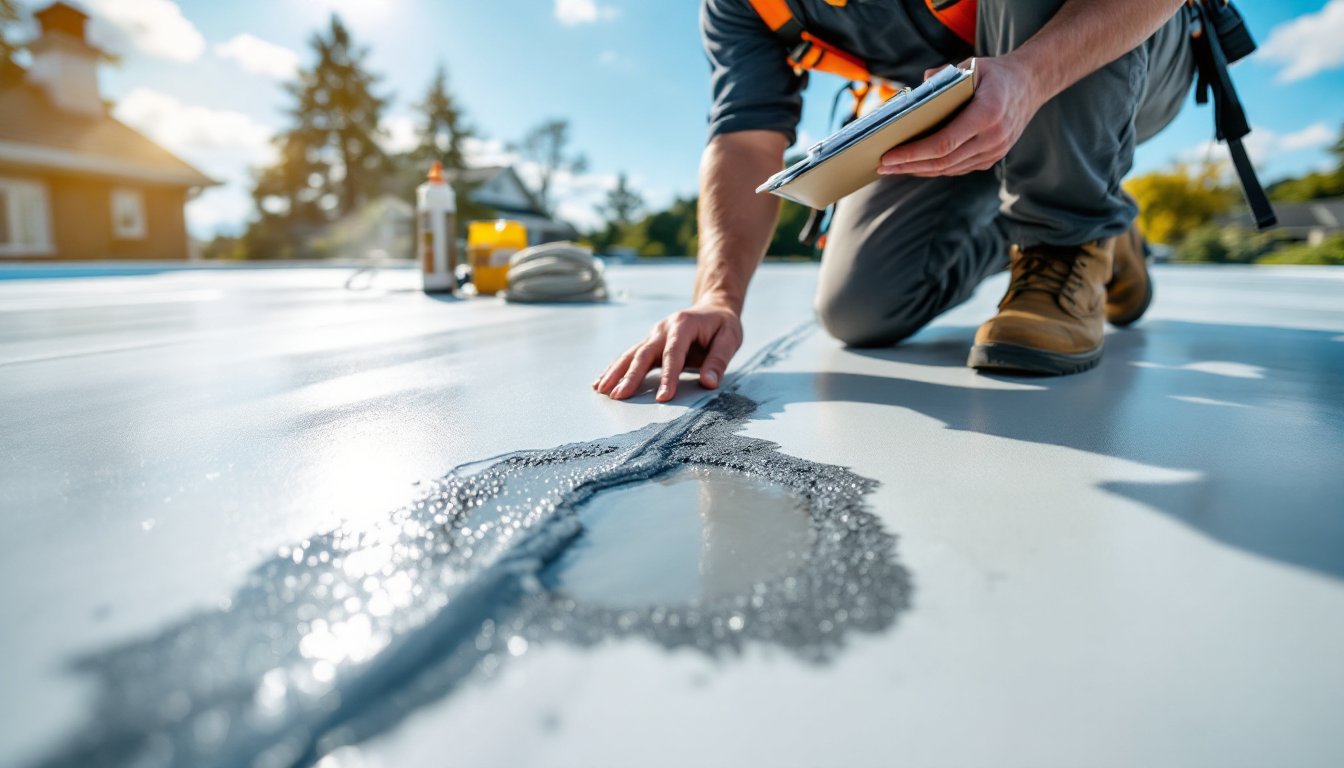
Ponding water is the silent killer. Because flat roofs have minimal slope, water pools in low spots instead of running off. Over weeks or months, standing water breaks down asphalt, degrades membranes, and forces its way through seams. Check your roof after heavy rain: if water sits for more than 24 hours, drainage is compromised.
Membrane blisters and bubbles occur when moisture gets trapped between layers during installation or when temperature swings cause expansion and contraction. A small blister may not leak yet, but it’s a weak point waiting to fail.
Cracked and splitting seams are the most common leak source. Seams are the joints where roofing sheets overlap, and they’re sealed with adhesive or heat-welded connections. UV exposure, foot traffic, and thermal stress eventually crack them open.
Punctures and tears happen from falling branches, hail, or careless contractor work during other repairs. A small puncture isn’t an emergency, but exposed membrane underneath will deteriorate fast.
Flashing failures occur where the roof meets walls, chimneys, or HVAC penetrations. Flashing, the thin metal or rubber pieces that direct water away, can separate, rust, or lose its seal over time. Water that gets behind flashing seeps into framing, so this problem is worth addressing quickly.
Before jumping to a repair, climb up (safely, with a ladder and a spotter) or use binoculars to document the damage. Take photos and note the roof’s age and material type: that information guides your next decision.
Patching and Sealant Solutions for Minor Damage
For small cracks, minor punctures, and seam separation, sealants and patch kits offer quick, low-cost fixes that can extend your roof’s life by several years.
Roofing cement and sealants come in caulk tubes or cans. Polyurethane-based sealants (such as Sikaflex or similar products) stay flexible as the roof expands and contract, making them more durable than basic silicone. Apply sealant into clean, dry cracks, smooth it with a putty knife, and let it cure per label instructions, usually 24 to 48 hours. This works for seam separation and small splits in bituminous (asphalt) roofs.
Roof patches and repair tapes are self-adhesive or require primer. They’re designed for small punctures and tears in membrane roofs (TPO, EPDM). Many come as kits with cleaning solution, primer, and a rubber patch. The process is straightforward: clean and dry the damaged area, apply primer if required, peel the backing, and press the patch firmly. These patches typically last 3 to 5 years if installed correctly.
A key advantage of patches is that they’re forgiving, if applied over a wet or dirty surface, they fail quickly, but the fix is inexpensive enough to retry.
DIY Patch Kits and When to Use Them
DIY patch kits make sense for damage smaller than 2 inches across and for homeowners comfortable working at height. They cost $15 to $50, require minimal tools (wire brush, knife, caulking gun), and take 30 minutes per patch. Safety gear is non-negotiable: wear slip-resistant shoes, use a secure ladder, and tie off if your roof is steep or high.
Don’t use patches for:
- Damage near seams or flashing, water will find cracks around the edges
- Widespread cracking or multiple punctures, a patch is triage, not a solution
- Older asphalt roofs with extensive UV damage, the base material is failing, and a patch won’t stop the rot
- Pooling water areas, without fixing drainage, water returns to the weak spot
Patches are bought time. A $30 patch might buy you 2 to 3 years before a professional membrane repair becomes necessary. That’s often the right trade-off for a homeowner facing a $3,000+ replacement, but be honest about whether you’re truly fixing the problem or just delaying it. Homeowners can find local contractors through platforms like HomeAdvisor’s flat roof repair service directory to get second opinions on whether DIY patching is appropriate for your situation.
Membrane Repair and Replacement Options
When patches aren’t enough, you’re looking at membrane repair or replacement. Modern flat roofs use synthetic membranes that last 15 to 40 years, depending on material and maintenance. The three most common types have distinct repair and cost profiles.
Comparing TPO, EPDM, and PVC Membranes
TPO (Thermoplastic Olefin) is the most popular choice for new roofs and replacements. It’s heat-welded at seams, white (reflective, lowering cooling costs), and costs $6 to $12 per square foot installed. TPO can be patched with adhesive or heat-welded patches, but seam repair requires heat-welding equipment, which most homeowners don’t have. A professional TPO repair runs $300 to $800 per seam. TPO has a 20 to 30-year lifespan.
EPDM (Ethylene Propylene Diene Monomer) is an older rubber membrane, black or tan, costing $4 to $8 per square foot installed. It’s easier to patch than TPO because seams are glued, not welded. Self-adhesive patches and liquid sealants work well. EPDM roofs typically last 15 to 25 years, but UV exposure degrades them faster without protective coatings. If you have an EPDM roof, prioritize preventative maintenance (see below) to avoid costly repairs.
PVC (Polyvinyl Chloride) is mid-range at $8 to $14 per square foot, white or tan, with heat-welded seams. It’s highly resistant to UV and ozone, making it ideal for harsh climates. Repair options mirror TPO: patches for small damage, professional heat-welding for seams. PVC roofs last 20 to 30 years.
For membrane repairs beyond patches, you’re hiring a professional unless you’ve trained in heat-welding or adhesive application. Labor costs $50 to $150 per hour, and material adds another $100 to $300. A full membrane replacement, removing the old roof and installing new material, runs $5 to $15 per square foot, or $5,000 to $25,000+ for a typical home. Resources like Angi’s cost guides and contractor reviews help homeowners compare local pricing and read contractor feedback before committing to major work.
Coating Systems and Preventative Maintenance
Roof coatings are liquid applications that seal the membrane, reduce UV damage, and reflect heat. They’re a cost-effective way to extend a roof’s life and lower energy bills. Acrylic coatings cost $1 to $3 per square foot and last 5 to 10 years before recoating is needed. Polyurethane coatings run $2 to $4 per square foot and last longer but are more expensive. Silicone coatings are the most durable at $3 to $5 per square foot and last 10 to 15 years: they also bridge small cracks and seal seams better than acrylics.
Coatings work best on roofs in decent condition, not on roofs with active leaks or extensive membrane damage. Prep work is critical: the surface must be clean, dry, and stable. Dust, mold, or algae growth prevents adhesion. If you hire a pro, they’ll pressure-wash (gently, to avoid membrane damage), inspect seams, and seal obvious problem areas before coating.
A coating is preventative maintenance, not a cure. It buys you 5 to 10 extra years on a roof that might otherwise need replacement in 3 to 5 years. For a 1,500 square-foot roof, a silicone coating costs roughly $4,500 to $7,500 installed, a fraction of a $15,000 replacement and a smart investment if your roof is otherwise sound.
Monthly or seasonal maintenance is cheaper than reactive repairs. After storms, inspect for debris, branches, and standing water. Clear gutters and downspouts: poor drainage accelerates all flat roof failures. Every 2 to 3 years, hose off dust and algae growth, and inspect seams and flashing. Catching separation or cracking early, before water intrusion, saves thousands.
For homeowners planning larger projects or weighing replacement timing, resources like ImproveNet’s renovation guides provide cost breakdowns and planning tools to compare patching, coating, and full replacement scenarios.
When to Call a Professional vs. DIY Repairs
Know your limits. Roofwork is inherently risky, falls account for thousands of home injuries annually. Add height, moisture, and exposure to weather, and the stakes rise fast.
DIY is reasonable for:
- Applying sealant to small cracks (< 2 inches)
- Installing self-adhesive patches on punctures
- Clearing debris and routine maintenance
- Replacing deteriorated flashing that doesn’t require structural work
- Applying or recoating sealant on low-slope (nearly flat) roofs where fall risk is lower
Hire a pro for:
- Heat-welding seams (requires training and equipment)
- Extensive membrane damage or widespread blistering
- Roof replacement or re-roofing (structural work, permits, warranty issues)
- Repairs on steep or high roofs
- Flashing work involving chimneys, skylights, or structural penetrations
- Roofs in poor condition where diagnosis is unclear
Most flat roof repairs don’t require permits, but membrane replacement does in many jurisdictions. Check with your local building department before starting work. If permits are needed, hiring a licensed contractor is safer, they pull permits, carry liability insurance, and provide warranties. A failed unpermitted roof repair can complicate insurance claims or home sales.
Cost trade-offs: A $40 DIY patch versus a $500 professional repair seems obvious, but a botched patch that causes water damage costing $5,000 in drywall and framing repair isn’t a bargain. Be honest about your skill level, the condition of the roof, and the stakes. When in doubt, get a free inspection from a local roofer. Most offer no-obligation assessments that clarify whether you’re looking at a quick fix or a bigger project.